Trout, salmon & herring
Trout, salmon and herring are all oily fish. In oily fish the healthy fats, which are full of Omega-3 fatty acids, are distributed throughout the fish’s body rather than being concentrated in the liver, as they are in white fish like cod and hake. Trout and salmon are both salmonid fishes, belonging to the same family, salmonidae. Herring belong to the family Clupeidae, along with sprats and European sardines, ie. the true sardine, Sardina pilchardus.
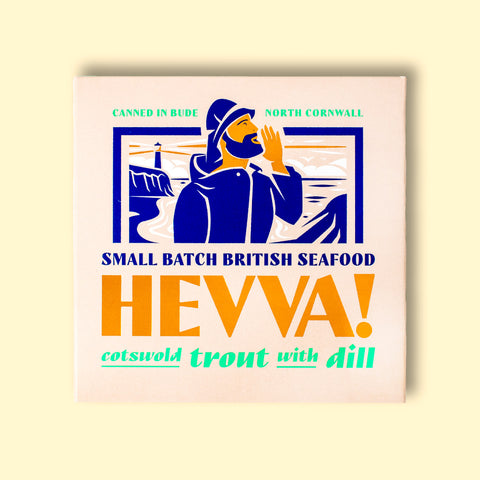
The Hevva and Fangst tins contain Rainbow trout (Oncorhynchus mykiss), which is primarily a freshwater fish. Hevva’s trout is farmed in a century-old trout farm in the Cotswolds region. Fangst’s in Danish freshwater.
Fangst salmon is farmed in the remote North Atlantic in the Faroe Islands. The fjords there have cool, steady temperatures, clear waters and strong currents making them an ideal spot for salmon. It is Atlantic salmon (Salmo salar). The herring or sild is Atlantic herring (Clupea harengus), caught in the Norwegian Sea, a location prized for its high quality herring.
More about trout, salmon and herring
- Norwegian Sea herring is high in Vitamin D, something we sun-rationed Brits can’t get enough of.
- A kipper is a salted and cold-smoked butterflied herring. A kipper is also called a red herring because the curing turns it copper-coloured. Kippers were once used to distract hounds from the hunt, in 19th Century fiction at any rate, and that’s where the term red herring, a plausible clue that leads nowhere, comes from.
- Using the earth’s magnetic field and their keen sense of smell, wild salmon leave the sea and locate the precise river where they were born in order to spawn. They swim upstream, away from estuaries where predators lurk to clear, oxygenated waters where their young stand a better chance of survival. The exhausting journey takes its toll and the adult salmon die soon after.
- Native to North America and Asia, Rainbow trout have been introduced to every continent except Antarctica. Indigenous crocodile icefish have proteins that work like antifreeze and stop ice crystals from forming in their blood streams. Rainbow trout lack these so wouldn’t survive the sub-zero temperatures.